These days, restaurant (POS) point-of-sale systems do much more than just bill customers. They assist with table management, staff performance monitoring, kitchen coordination, inventory tracking, customer engagement workflow support, and outlet analytics.
The result of this change, restaurants are increasingly assessing whether self-hosted restaurant management software would be a better fit for their long-term operational requirements or whether conventional cloud-only platforms like Petpooja, Square, and Odoo still meet those needs.
This article explains:
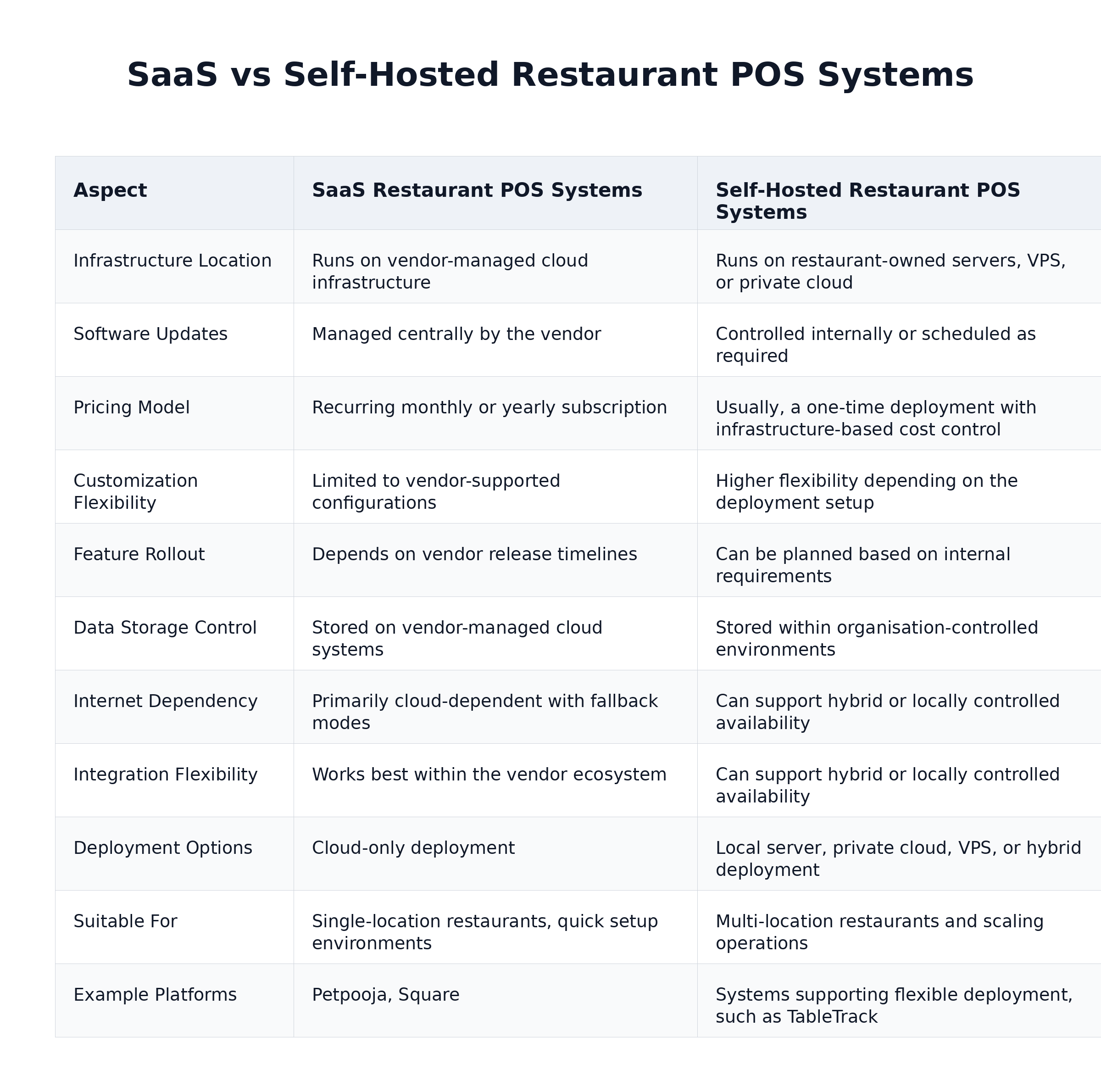
How SaaS restaurant POS platforms differ from self-hosted deployments
When restaurants typically consider switching
What operational features matter most during evaluation
where platforms like TableTrack fit within the evolving restaurant technology landscape
Why Restaurants Start Looking Beyond Standard Cloud POS Platforms
Cloud POS solutions are widely adopted because they are easy to deploy, require minimal technical setup, and allow restaurants to start operations quickly without infrastructure investment.
However, as restaurant operations scale, priorities begin to change.
Instead of focusing only on quick billing setup, restaurants start focusing on:
Multi-outlet coordination
Inventory visibility across locations
Kitchen workflow routing
Data ownership
Deployment flexibility
Integration compatibility with internal tools
At this stage, many businesses begin comparing SaaS platforms with alternatives that support self-hosted deployment models, especially when operational standardisation across outlets becomes important.
For growing restaurant brands, software decisions gradually shift from convenience-focused selection toward infrastructure-aligned planning.
Understanding the Difference Between SaaS and Self-Hosted Restaurant POS Systems
Overview of Petpooja, Square POS, and Odoo in Restaurant Operations
Understanding how these platforms are commonly used in actual restaurant settings is helpful before comparing alternatives.
Petpooja
Petpooja is used across India and is particularly popular among small and mid-sized restaurants, cafes, and quick-service outlets.
It typically supports:
Billing workflows
Inventory tracking
Online ordering integrations
Menu configuration
Outlet reporting dashboards
It is ideal for restaurants that want quicker onboarding times and less infrastructure involvement because it is cloud-managed.
However, compared to platforms that support self-hosted architecture, deployment flexibility is constrained.
Square POS
Square Point of Sale (POS) is widely used worldwide and is particularly prevalent in cafés, takeaway counters and mobile-first restaurants.
Square is frequently used by restaurants for:
Fast onboarding
Simple interface design
Integrated payment ecosystem
Hardware compatibility flexibility
However, workflow depth may vary with restaurant complexity, especially in multi-kitchen routing or large-scale outlet coordination.
Odoo POS
Rather than being a stand-alone platform with a restaurant focus, Odoo offers POS functionality as part of a larger ERP environment, which is frequently used by organisations that already rely on Odoo modules, such as:
Accounting
CRM
Inventory
Procurement systems
Odoo allows for extensive configuration across business departments due to its modular structure. However, depending on the integration scope and customisation requirements, implementation complexity may rise.
Where Self-Hosted Restaurant Platforms Like TableTrack Fit
Self-hosted restaurant platforms are usually evaluated by businesses planning operational expansion or infrastructure standardisation across outlets.
These platforms become relevant when restaurants begin prioritising:
Deployment control
Integration flexibility
Centralised reporting architecture
Custom workflow alignment
Multi-location operational visibility
Solutions such as TableTrack are often considered in this category because they combine restaurant-specific modules with deployment flexibility rather than operating strictly as vendor-managed SaaS tools.
This makes them part of infrastructure planning discussions rather than only POS selection conversations.
Website: https://tabletrack.froid.works/?show=demo_landing
Feature Comparison: TableTrack vs Petpooja vs Square POS vs Odoo
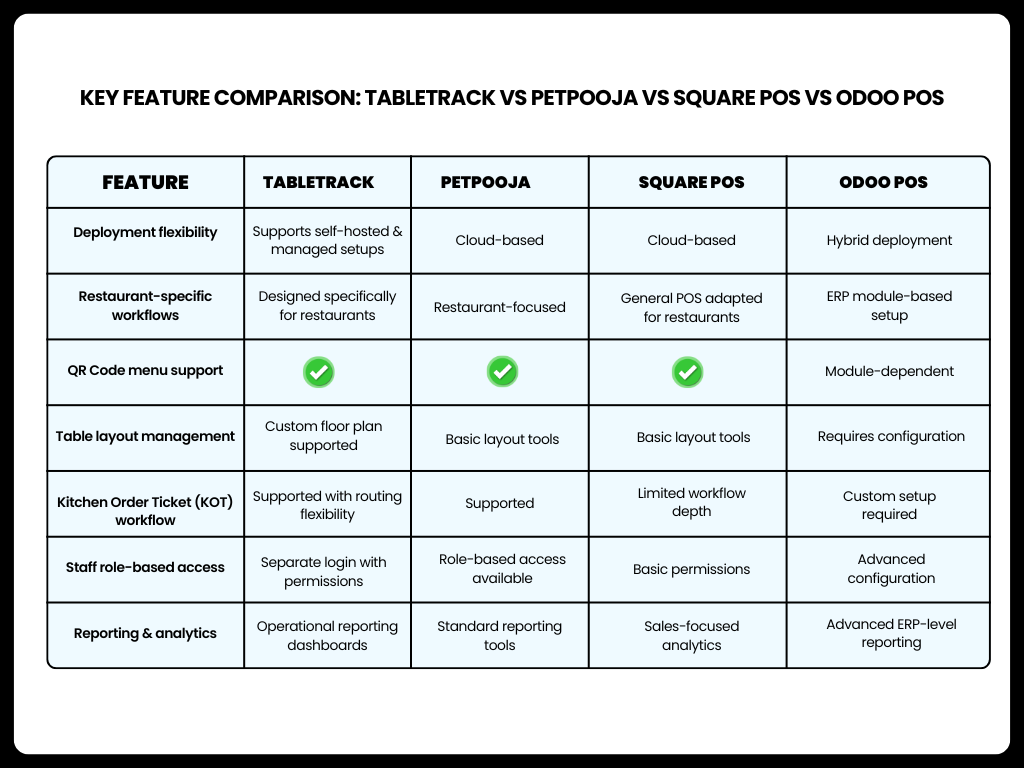
Key Factors Restaurants Should Compare Before Selecting a POS Platform
Choosing the right system depends less on brand familiarity and more on operational alignment with restaurant workflows.
Restaurants should evaluate:
Table visualization tools
kitchen routing capability
Inventory accuracy
Multi-location coordination
Analytics clarity
Integration flexibility
Deployment architecture options
For some businesses, SaaS simplicity is ideal. For others, infrastructure ownership becomes more important over time as operational complexity increases.
Evaluating Odoo as a Restaurant POS Alternative
Odoo provides one of the most flexible environments among POS platforms because it operates as a modular ERP system rather than a restaurant-first solution.
However, restaurants typically evaluate it differently compared to purpose-built POS tools.
Odoo works best when:
Organisations already use ERP modules.
Integration across departments is required.
Centralised accounting workflows are necessary.
Internal technical resources are available.
Restaurants looking specifically for dining workflow optimisation sometimes compare Odoo with restaurant-focused systems such as TableTrack, which are designed primarily around service-floor operations instead of enterprise-wide process layers.
Key Factors Restaurants Should Compare Before Selecting a POS Platform
Choosing the right system depends less on brand familiarity and more on operational alignment with restaurant workflows.
Restaurants should evaluate:
Table visualization tools
kitchen routing capability
Inventory accuracy
Multi-location coordination
Analytics clarity
Integration flexibility
Deployment architecture options
For some businesses, SaaS simplicity is ideal. For others, infrastructure ownership becomes more important over time as operational complexity increases.
Final Thoughts
Depending on the size of the company, the complexity of operations, and the long-term infrastructure plan, restaurant point-of-sale systems meet a variety of needs.
Restaurants that prioritise ease of use and quick onboarding continue to find success with cloud platforms like Petpooja and Square POS.
For businesses already functioning in integrated business environments, ERP-style systems like Odoo provide greater modular flexibility.
In addition to POS billing, kitchen coordination, inventory workflows, and centralised reporting visibility within a single operational system, businesses investigating self-hosted deployment flexibility are increasingly comparing restaurant-focused platforms such as TableTrack.
Comprehending these distinctions enables eateries to select solutions that are in line with both current needs and future expansion strategies.