Every night, restaurants throw away food that cost real money to buy, store, and prep. At the same time, on a different night, the same restaurant runs out of its most popular dish at 8 pm on a Saturday. Both things happen constantly. Both are avoidable. And until recently, most restaurant owners just accepted them as the cost of doing business.
That's changing fast in 2026. Food waste costs the restaurant industry over $160 billion a year globally. A chunk of that isn't bad luck or bad ingredients — it's bad forecasting. Chefs and managers have always ordered based on gut feeling, last week's sales, and a safety margin "just in case." That approach worked when restaurants were simpler businesses.
It doesn't hold up anymore, especially with rising ingredient costs and razor-thin margins. AI-powered inventory prediction is the quiet fix nobody's talking about loudly enough. Let's get into what it actually does, why it works, and whether it makes sense for your restaurant.
The Real Cost of Getting Inventory Wrong
Most restaurant owners think of food waste as spoiled vegetables and half-eaten plates coming back from tables. That's part of it, but the higher cost usually happens earlier — at the ordering and prep stage.
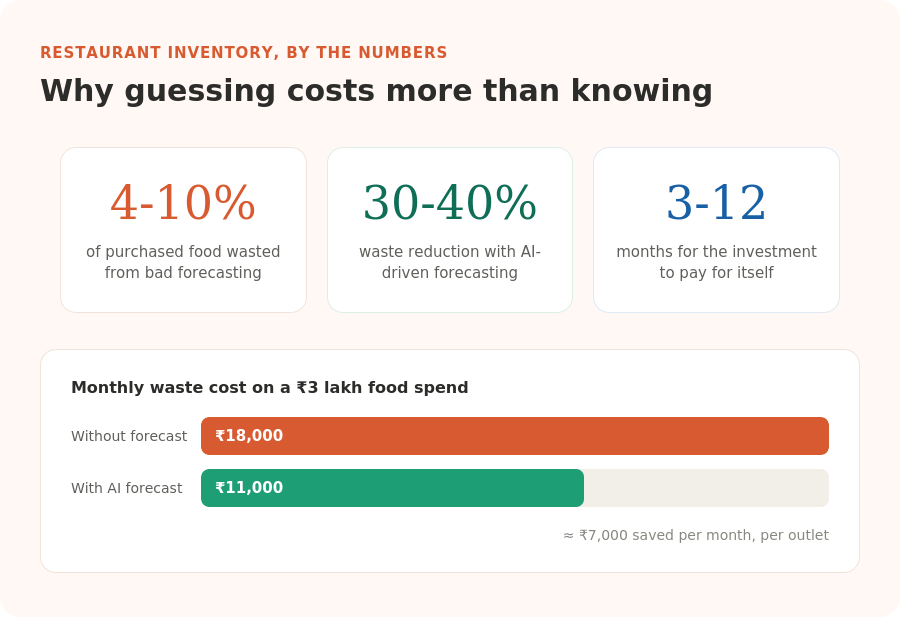
Restaurants typically waste somewhere between 4% to 10% of all the food they purchase because of inaccurate forecasting. Think about what that means in real numbers. If your monthly food cost is 3 lakhs, even a conservative 6% waste figure is 18,000 a month — vanishing for no reason other than ordering the wrong quantities.
And it's not a one-directional problem. Restaurants don't just over-order and waste. They also under-order and run out, which has its own cost. A guest who can't get their usual order isn't just disappointed for one visit. They start wondering if they should bother coming back. Both overstocking and understocking come from the same root issue: nobody has reliable data on what's actually going to be needed tomorrow.
The traditional way of solving this — a manager doing a stock count, checking it against memory, and placing an order — was never built for precision. It was built for "good enough." And good enough costs restaurants real money every single week.
What AI Inventory Prediction Actually Does
Here's the part that's easy to overcomplicate. Strip away the jargon and AI inventory prediction does three things well.
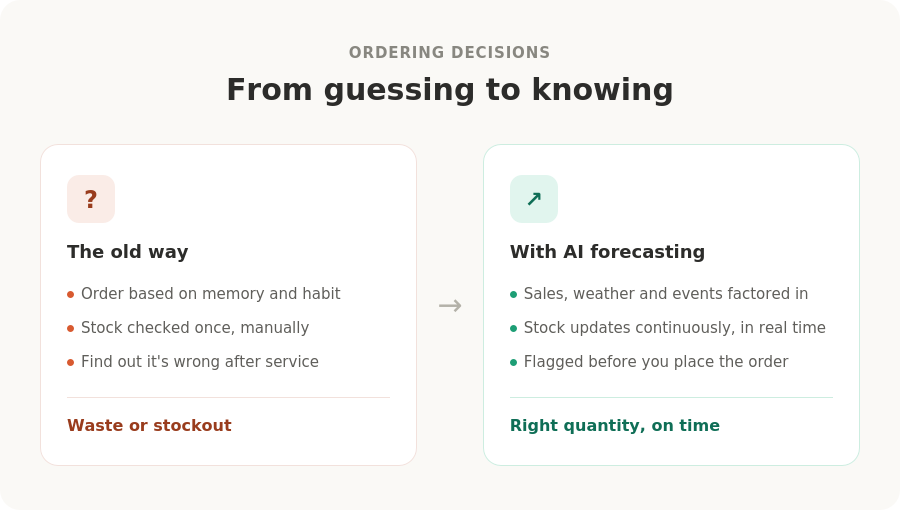
It looks at patterns humans miss. A manager remembers that Fridays are busy. AI looks at exactly how busy — broken down by hour, by dish, by weather, by whether there's a cricket match on, by whether last Friday was a holiday weekend. It catches correlations that aren't obvious from memory alone, like the fact that orders for a particular curry spike whenever it rains, or that biryani sales jump 20% on paydays.
It updates constantly, not once a month. Traditional inventory planning happens in batches — someone counts stock, places an order, and repeats next week. AI-based systems pull from your POS data continuously. The prediction gets sharper every single day, not just when someone remembers to update a spreadsheet.
It tells you what to do about it, not just what happened. This is the real shift. Instead of a report that says "you wasted 12% of your tomatoes last month," a good system tells you, before you place this week's order, exactly how many kilos you're likely to need.
None of this requires a restaurant to become a tech company. It requires connecting the data that's already being generated — every order, every bill, every inventory entry — and letting the system do the pattern-matching that's genuinely hard for a human to do consistently, shift after shift.
What This Looks Like in a Real Restaurant
Forget the abstract version for a second. Here's what changes day-to-day when a restaurant actually uses this. A manager used to start the week by guessing how much chicken to order based on "it's usually busy this time of year." Now, the system has already looked at the last several weeks of sales, factored in that a local college has exams this week (lighter footfall expected), and recommends a quantity that's noticeably lower than what the manager would have ordered on instinct. That's the difference between guessing and knowing.
Or take a Saturday evening rush. Instead of the kitchen running out of the best-selling dish at 7:45 pm and scrambling to tell guests it's unavailable, the system flagged three days earlier that Saturday demand for that dish was trending up — enough to justify ordering extra stock before the weekend, not after running out. This is also where the kitchen display system and inventory prediction start working together.
As orders come in through the day, stock levels update in real time. If something is about to run low mid-service, someone gets an alert before a guest orders it and finds out it's gone. The result isn't a dramatic, overnight transformation. It's a steady reduction in two things that have always quietly eaten into restaurant margins — waste at one end, stockouts at the other.
The Numbers Are Hard to Ignore
This isn't a "might help" technology. The results being reported across the industry are consistent enough to take seriously. AI-powered demand forecasting can help restaurants cut food waste by 30–40% in many cases.
Some multi-location chains using AI-driven inventory optimization have reported food waste reductions in the range of 20% after implementation — a meaningful number when food cost is typically one of the largest line items on a restaurant's P&L, alongside labour. It's not only about waste, either.
Restaurants using AI-backed forecasting have reported reductions in labour costs as well, because predictable demand also means more accurate staff scheduling. The payback period for most restaurants implementing this kind of system falls within three to twelve months.
That's not a multi-year bet. For most independent restaurants and small chains, the cost savings from reduced waste alone are enough to justify the investment well within the first year.
You Don't Need to Be a Large Chain to Use This
There's a common misconception that AI-driven inventory tools are only for big restaurant groups with data science teams and large IT budgets. That was true a few years ago. It isn't anymore.
The shift has been from AI as a specialised, expensive add-on to AI as a built-in feature of restaurant management software that any restaurant can use — single location or fifty. There's no need to hire a data scientist or build a custom model. The system learns from your sales history automatically, and the predictions get sharper the longer it runs.
This matters a lot for independent restaurants and small chains in markets like India, where the gap between "enterprise software" and "what a single restaurant can actually afford and operate" has historically been wide. That gap is closing.
Where to Start If You Want to Try This
You don't need to overhaul your entire operation to see results. A few practical starting points:
Look at your highest-waste categories first. Most restaurants already know which two or three ingredient categories get wasted the most — usually perishables like vegetables, dairy, or seafood. Start there before optimising everything at once.
Make sure your POS and inventory are actually talking to each other. AI-driven prediction is only as good as the data feeding it. This is one of the strongest arguments for an all-in-one restaurant management platform rather than a patchwork of separate apps.
Give it a few weeks before judging the results. Forecasting accuracy improves the more data the system has seen. The real value shows up after it's had a few cycles to calibrate.
Don't expect it to replace judgment — expect it to support it. AI doesn't know you're launching a new menu item next week or that a local festival is coming. A manager who combines the system's data with situational knowledge always gets better results.
Why This Starts With the Right Foundation
Before a restaurant can even think about AI-driven forecasting, there's a more basic requirement: your POS, your inventory, and your kitchen operations need to be talking to each other in the first place. AI sitting on top of disconnected spreadsheets and a separate billing tool doesn't have clean data to learn from — and bad data in means unreliable predictions out.
This is really the starting point for any restaurant considering this path. A unified system — where billing, table management, KOT generation, and sales reporting already live in one place — is what makes smarter forecasting possible down the line. TableTrack brings these pieces together for restaurants of all sizes, from a single café to a multi-branch chain, which is exactly the kind of connected foundation this next wave of restaurant technology is built on.
Whether or not a restaurant is using AI-driven prediction yet, getting the basics — POS, inventory, KOT, reporting — working as one connected system is the real first step. Everything else follows from there.